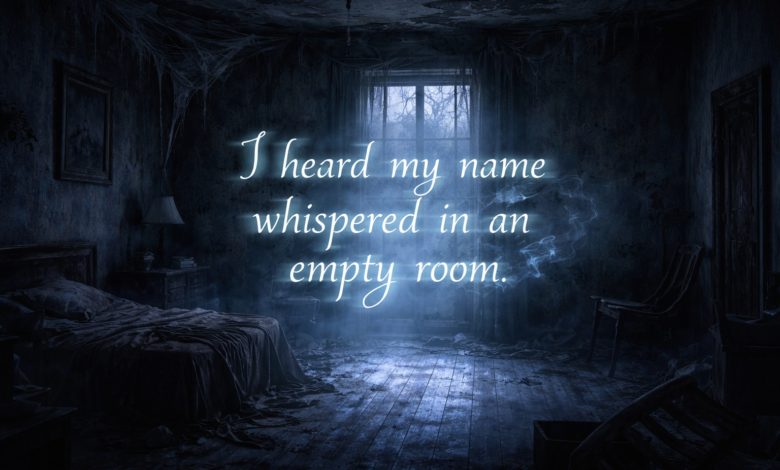
I heard my name whispered in an empty room.
It wasn’t loud. It wasn’t dramatic. It was the kind of sound that could be mistaken for memory itself—soft, intimate, impossible to locate. Still, it froze me where I stood, one hand on the light switch, heart suddenly pounding as if it had been waiting years for that exact moment.


“Daniel.”
No one had called me that in a long time.
The apartment was bare except for dust and boxes. I had returned to my childhood home to sell it after my mother’s death, a task I had postponed for months under the excuse of work, distance, life. The truth was simpler: I was afraid of what this place remembered about me.
I told myself the whisper was stress, grief, the way silence plays tricks on a person. I flicked on the light. The room was empty—no movement, no shadows out of place. Just the old living room, stripped of furniture, its walls still bearing faint outlines where family photos once hung.
I laughed under my breath, sharp and humorless.
“Get it together,” I muttered.
Then I heard it again.
“Danny.”
That name landed differently. It wasn’t just sound—it was time travel. It pulled me backward with such force that I had to grab the back of a chair to steady myself.
No one called me Danny anymore. No one except one person.
My brother.
Ethan had died twenty years ago. Officially, it was an accident. A fall into the river behind the house. Slippery rocks. Poor visibility. Tragic, unavoidable.
That was the story everyone told.
That was the story I let them believe.
I followed the sound down the hallway, my footsteps slow, hesitant. Each step felt like crossing a line I had drawn long ago and sworn never to step over again. The whisper led me to the door at the end—the room that had once been Ethan’s.
I hadn’t gone in there since the night he died.
The door creaked open. The air inside felt colder, heavier, as if it had been sealed away with everything I refused to remember. Moonlight spilled through the window, illuminating the faint outline of a child’s bed and the desk where Ethan used to sit, sketching superheroes and impossible machines.
“Why are you here?” I asked the empty room.
The whisper came again, closer now.
“You left me.”
My chest tightened. My mouth went dry.
“I didn’t,” I said, but the words felt weak even as I spoke them.
Memory surfaced—not all at once, but in fragments. A fight. Raised voices. Rain pounding the ground outside. Ethan’s face red with anger and hurt as he accused me of something I had never forgiven him for saying.
You think you’re better than me.
You’re ashamed of us.
I had shoved him. Not hard. Just enough to make a point. Just enough to send him stumbling back toward the riverbank.
I remembered shouting his name.
I remembered the splash.
What I had buried—the truth I had wrapped in silence and self-deception—was not that he fell.
It was that I didn’t jump in after him.
I stood there, frozen, listening to him struggle, telling myself someone else would hear, someone else would help. I told myself I was scared, that I couldn’t swim well enough, that it was too dark.
I told myself lies.
The whisper filled the room, no longer gentle.
“Why didn’t you come?”
Tears burned my eyes. I sank to the floor, the weight of the years pressing down on me all at once. Every choice I had made—every relationship I had sabotaged, every distance I had created—suddenly made sense. I had built my life around running from that moment, from that version of myself.
“I was a coward,” I said aloud. My voice broke. “I was afraid.”
Silence followed—not empty this time, but listening.
“I thought if I never said it out loud, it wouldn’t be real,” I continued. “I thought I could outgrow it. But you don’t outgrow the truth. It grows into you.”
For the first time, the whisper didn’t accuse.
It softened.
“You stayed broken.”
I looked up, though I still saw no one. “I didn’t know how to be anything else.”
The room felt warmer then, as if the air itself had exhaled. I realized something I hadn’t allowed myself to consider before: the past wasn’t here to punish me. It was here because I had never faced it.
“I’m sorry,” I said. Not as an excuse. Not as a defense. Just as truth.
The whisper faded—not abruptly, but gently, like a tide pulling back.
When I finally stood, the room was just a room again. Dust. Moonlight. Silence.
But I was not the same.
The next morning, I called my sister for the first time in years. I told her the truth. Not the softened version. Not the one that made me easier to forgive. I told her everything. She cried. I cried. The silence between us was painful—but it was honest.
Before leaving the house for the last time, I stood in the living room and listened. There were no whispers now. No voices. Just the quiet presence of a past finally acknowledged.
I locked the door behind me and stepped into the future carrying something I had avoided my whole life—not guilt alone, but responsibility.
And for the first time, that felt like the beginning of freedom.
Also More: She Cried When She Saw The Sweater